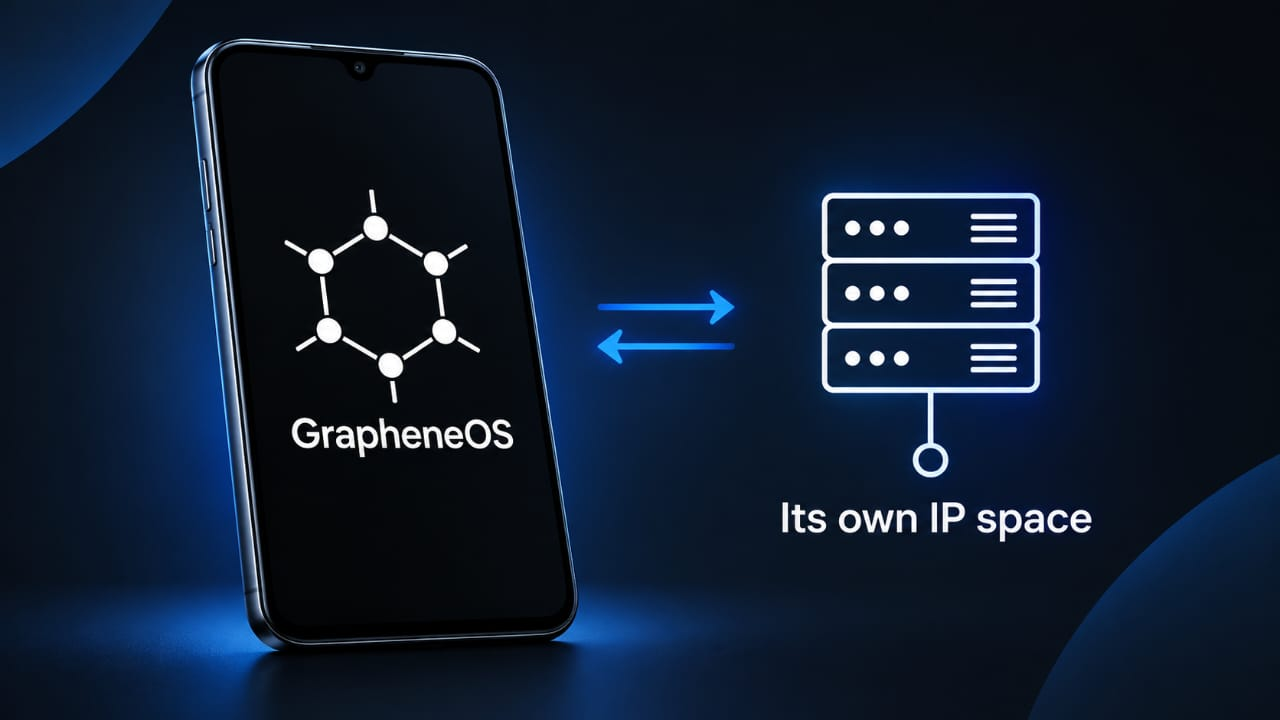
GrapheneOS, the security-focused mobile operating system, now owns its own block of internet addresses. In a post on X on October 2, the project said ARIN, the American Registry for Internet Numbers, fulfilled its request for an IPv4 /22 through the registry's IPv4 Waiting List earlier that day. Together with two IPv4 /24 blocks it had already obtained and an IPv6 /36, the project now holds address space registered directly to it, which it announces to the internet through its hosting provider.
What the Project Owns Now
The post lists four blocks: the IPv6 range 2602:F4D9::/36, the IPv4 ranges 23.149.124.0/24 and 23.149.125.0/24, and the larger IPv4 range 206.220.120.0/22. The two /24 blocks came first and were obtained quickly under section 4.10 of ARIN's number resource policy manual. GrapheneOS says it requested them for ns1 and ns2, its two name servers, which run as anycast DNS. Anycast means the same address is announced from several locations at once, so queries are answered by whichever server is closest.
The /22 is the newer addition, and it came through ARIN's IPv4 Waiting List rather than a direct policy request, a queue organizations join when no free IPv4 space is available to hand out on demand. The IPv6 /36 was not requested separately. According to the project, the provider upgraded it to that size automatically once the second IPv4 /24 arrived.
Where the New Space Is Going
GrapheneOS says the /22 will be deployed across four separate locations as four /24 blocks, which works out to 254 usable addresses in each place. The first /24 has already gone to the project's Toronto location, where it hosts its mail server and plans to switch that server over to the new addresses soon. The post does not give a date for that move or name the other three locations.
The Toronto server is sponsored by Xenyth, a small Canadian company with locations in Toronto, Ashburn, and New York City. Xenyth supports BGP for its customers, the routing protocol that lets a network tell the rest of the internet which addresses it holds. GrapheneOS says it uses that support to announce its own IP space and to steer inbound traffic. On the IPv6 side, the project describes a bare minimum of one /48 each for ns1, ns2, and Toronto, with more server locations beyond those.
Why Owning Address Space Matters
The thread frames this as infrastructure work and does not spell out a privacy angle, so the following is general background rather than a statement from the project. Address space leased from a hosting provider belongs to that provider, and moving servers usually means changing addresses. Space registered to the organization itself can stay with it, which makes it easier to change providers, run servers in several places, and control how traffic reaches them without depending on any one company's network.
Questions From the Replies
Not everyone who replied was convinced the announcement needed explaining, or that it needed to happen on X at all. One reader said the news was interesting operations detail but not relevant to users of the phone OS. Another asked why GrapheneOS needs two existing /24 networks plus a /22 while IPv4 space remains scarce, and how many of the addresses it realistically expects to use. A third asked for a plain explanation of why any of it matters, which prompted the project to add the follow-up posts explaining prefix sizes. As of publication, the thread shows no direct answer to the usage question.
The scarcity concern is a fair one, since IPv4 space is a limited resource and ARIN hands it out through a waiting list for that reason. The project's own answer so far is practical: it plans to run the /22 as four separate announced blocks in four places, alongside the earlier DNS blocks.
Sources
- GrapheneOS on X, "Earlier today, ARIN fulfilled our request for an IPv4 /22," October 2, 2026: x.com/GrapheneOS
- GrapheneOS on X, follow-up posts on IPv4 /22 and /24 sizing and Toronto deployment, October 2, 2026: x.com/GrapheneOS
- GrapheneOS on X, reply on the Toronto server and BGP, October 2, 2026: x.com/GrapheneOS
- GrapheneOS on X, reply on the IPv6 /36 and /48 prefix sizes, October 2, 2026: x.com/GrapheneOS
- Xenyth: xenyth.net
This article was written by DigitalEscapeTools based on GrapheneOS's posts on X and publicly available information at the time of publication.