The Short Version
4.4 / 5 — Proton's Lumo just went from "a fine privacy-friendly chatbot" to something you could actually use as your main AI assistant. Reasoning, image generation, real web search, and memory are all here now, and every part of it still runs under Proton's zero-access encryption, with no training on your conversations and no ad targeting.
Best for: anyone already inside the Proton ecosystem, or anyone who wants a genuinely capable assistant without handing every conversation to a US ad-tech company.
Proton built Lumo as the AI equivalent of Proton Mail: same zero-access encryption, same no-logs policy, same "we literally cannot read your data" architecture, just applied to a chatbot instead of an inbox. The problem with version 1 was never the privacy model, it was the gap in raw capability compared to ChatGPT, Claude, or Gemini. Lumo 2.0, released on June 30, 2026, is Proton's attempt to close that gap for good, and it's a much bigger release than the version number suggests.
What's Actually New in 2.0
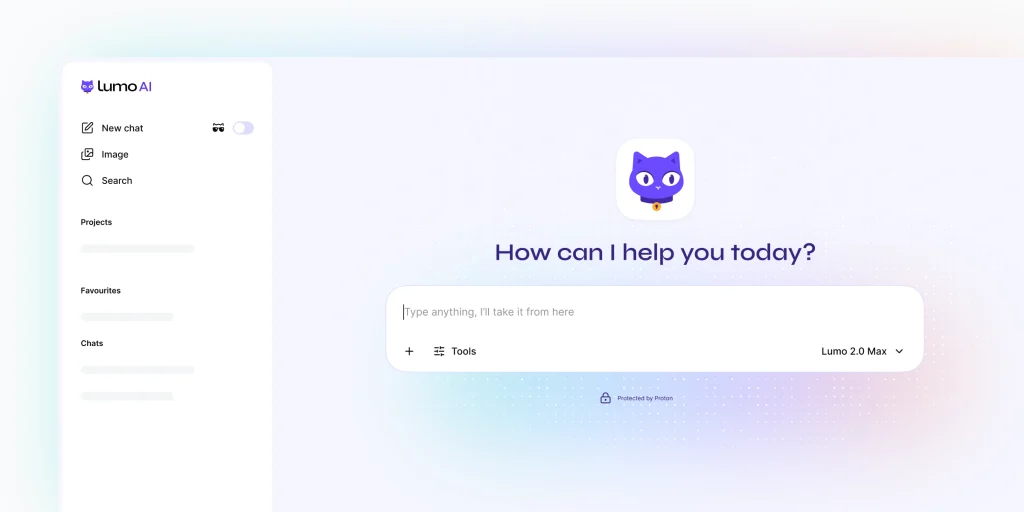
Lumo 2.0 was rebuilt on a new architecture rather than patched on top of the old one, and it shows up most clearly in two new response modes: Fast and Thinking. Fast is for quick, everyday questions, and Proton says it answers those up to 76% faster than Lumo 1.4 did. Thinking is a genuinely new capability for Lumo, a multi-step reasoning mode that shows its work in a visible "thinking" state while it walks through harder problems, the same basic idea as the reasoning modes in ChatGPT and Claude.
Proton backs this up with numbers from the Artificial Analysis Intelligence Index, an independent benchmark covering agents, coding, scientific reasoning, and general knowledge. By Proton's own reporting, Lumo 2.0 Lite scores around 127% higher than Lumo 1.4 on that index, and the flagship Lumo 2.0 Max scores roughly 240% higher. Those are Proton's numbers, not independently reproduced ones, so treat them as a directional claim rather than gospel, but the direction lines up with what reviewers have reported after actually using it.
It Can Finally See and Draw

Lumo 2.0 is multimodal now, which it wasn't before. You can upload a photo, screenshot, chart, or document and ask questions about it, generate an image from a text prompt or a rough sketch, or edit an existing image inside the same conversation. Proton's zero-access encryption covers this too: uploaded images and generated ones are encrypted so that, per Proton, no one, not even Proton itself, can access them.
Memory That You Actually Control
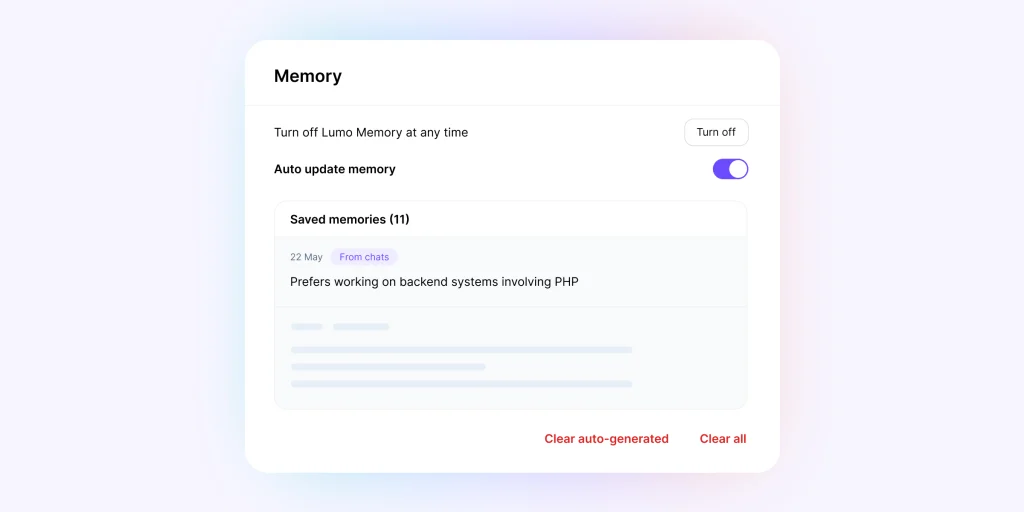
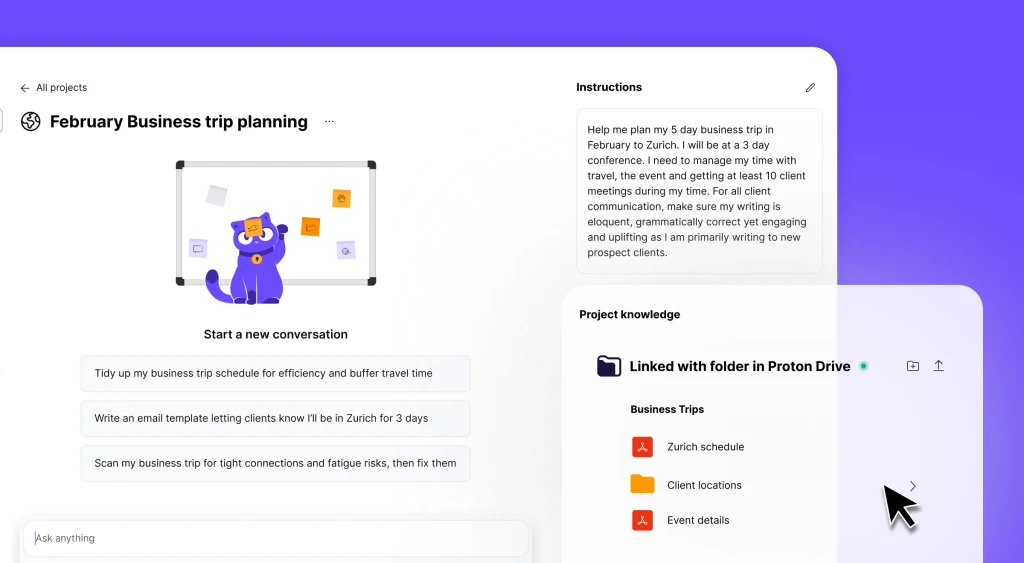
The other headline feature is user-controlled Memory, paired with Projects. Memory lets Lumo carry your preferences and working context across conversations instead of starting from zero every time, but unlike most competitors, you decide what it remembers, what it forgets, and what it's never allowed to learn in the first place. Combined with Projects, encrypted workspaces that group related chats, files, and instructions, it starts to feel less like a search box and more like a workspace. The context window has also doubled, so it holds longer conversations and reasons across bigger documents without losing the thread.
Web Search That Actually Cites Things
Lumo 1.4's web search was one of its weaker points. In 2.0, Proton says it pulls live results across the web, including current news, financial data, and weather, and cites its sources so you can verify what it's telling you instead of taking it on faith. Proton says the result is fewer hallucinations and more complete answers, which is the same claim every AI company makes about its own search, but the sourcing and citations are at least there to check against, which Lumo didn't consistently offer before.
Pricing
| Plan | Price | What you get |
|---|---|---|
| Lumo Free | $0 | Core Lumo 2.0 features, no Proton account required |
| Lumo Plus | $12.99 / month | Unlimited chats, Projects, advanced image generation, priority access to the fastest models |
| Lumo Professional | $14.99 / user / month | Everything in Plus, plus team admin controls and secure collaboration for businesses |
You don't need a Proton account to try Lumo, though creating one lets your chat history sync across devices under the same zero-access encryption. There are apps for iPhone and Android.
How It Actually Compares
Proton's own claim is that user testing shows people can no longer reliably tell Lumo 2.0 Max apart from the latest models from OpenAI and Anthropic in everyday use. That's a strong claim worth being skeptical of; it's coming from Proton, about Proton's own product. Early hands-on coverage has been more mixed than that: some reviewers found it a genuine leap for a privacy-focused assistant, while others, testing it in languages other than English, ran into rougher, less polished responses than they'd get from a frontier model. The honest read is that Lumo 2.0 closes a real gap rather than erasing it, and where it lands for you depends heavily on the kind of tasks you actually throw at it.
What's good
- Zero-access encryption on chats, images, and memory
- No training on your conversations, no logs, no ad profiling
- Real reasoning mode and multimodal support, finally
- Web search with actual source citations
- Open source, European infrastructure, works with no account
- Generous free tier for everyday use
Where it still lags
- Proton's benchmark claims are self-reported
- Some non-English responses have been reported as rougher
- Advanced image generation and priority models are paywalled
- Smaller plugin/integration ecosystem than ChatGPT or Gemini
Frequently Asked Questions
Do I need a Proton account to use Lumo?
No. Lumo is free to use at lumo.proton.me without an account. Creating a Proton account just lets your chat history sync across devices under zero-access encryption.
Does Lumo train on my conversations?
No. Proton says conversations are never logged or used to train future models, and zero-access encryption means Proton itself cannot read them.
Is Lumo 2.0 as good as ChatGPT or Claude?
It's close for a lot of everyday tasks, and Proton's own benchmark numbers claim it's closer than ever. It's not a universal replacement for frontier models on every task, but for most day-to-day use it's now genuinely competitive rather than a clear step down.
What does Lumo Plus add over the free plan?
Unlimited chats, Projects, advanced image generation, and priority access to Proton's fastest models, for $12.99/month.
Sources
- Proton's official Lumo 2.0 announcement
- Help Net Security coverage
- CyberInsider coverage
- 9to5Mac coverage
This review was written by DigitalEscapeTools based on Proton's official announcement and published third-party coverage at the time of publication. It contains an affiliate link, as disclosed above.